Posted on Leave a comment

How to Clean and Care for Your Vinyl Collection: A Field Guide

A vinyl record is a precision-cut groove of music. Treated well, it can outlast you; treated poorly, it can degrade in a season. This is the routine our team uses to keep our personal collections — and the records we ship — sounding the way they were pressed to.

Why caring for your records actually matters

Dust isn’t just dirt — it’s an abrasive. Every time a stylus drags through a particle of dust, it carves a microscopic scratch into the groove wall. Multiply that across thousands of revolutions, and a record that should sound rich and present becomes harsh, sibilant, and noisy. The good news: most of this damage is preventable with a five-minute routine.

The daily care basics

  • Handle by the edges. Skin oils transfer to the playing surface and attract dust. If you must touch the surface, use the label.
  • Brush before every play. A carbon-fibre anti-static brush, dragged in the direction of the groove, removes 90% of surface dust. It takes ten seconds.
  • Cue the stylus down by hand or lever. Dropping the tonearm is the single fastest way to chip a stylus and gouge a groove.
  • Return to the inner sleeve immediately. A record left on the platter — or worse, on the floor sleeve-less — collects dust that no brush can remove without a wet clean.

Wet cleaning: when and how

For new records, a brush is enough. For used records (especially anything found in a charity shop, a basement, or a collector’s estate), wet cleaning is non-negotiable. There are three tiers worth knowing:

  1. Distilled water + a drop of pure surfactant, applied with a microfibre cloth in circular motions, then a clean cloth to dry. Cheap, effective for casual collectors.
  2. A spin-clean style manual rinse. The record sits in a bath of cleaning fluid while you rotate it through brushes. Good for batches of dirty pickups.
  3. An ultrasonic cleaner. Premium, expensive, and absurdly effective — cavitation lifts grime out of grooves that no brush can reach.

Whichever route you take, dry thoroughly before sleeving — any residual moisture will warp paper sleeves and grow mould.

Storage: the unsung hero of record longevity

The fastest way to destroy a record collection isn’t playing it. It’s storing it badly. The rules:

  • Always vertical, never stacked. Pressure deforms vinyl over time.
  • Out of direct sunlight, away from radiators. Heat warps records permanently within hours of direct exposure.
  • Replace the paper inner sleeves that came with reissues. Anti-static rice-paper or polylined sleeves are inexpensive and prevent the paper fibres that cause the crackle in older records.
  • Outer poly sleeves. A clear poly outer protects the jacket art and seals against dust ingress — a worthwhile investment for any record you care about.

The stylus is half the equation

A clean record played with a dirty or worn stylus is just as bad as a dirty record played with a fresh one. A few rules:

  • Inspect the stylus tip monthly. A magnifier or smartphone macro lens will reveal any fluff stuck to the tip.
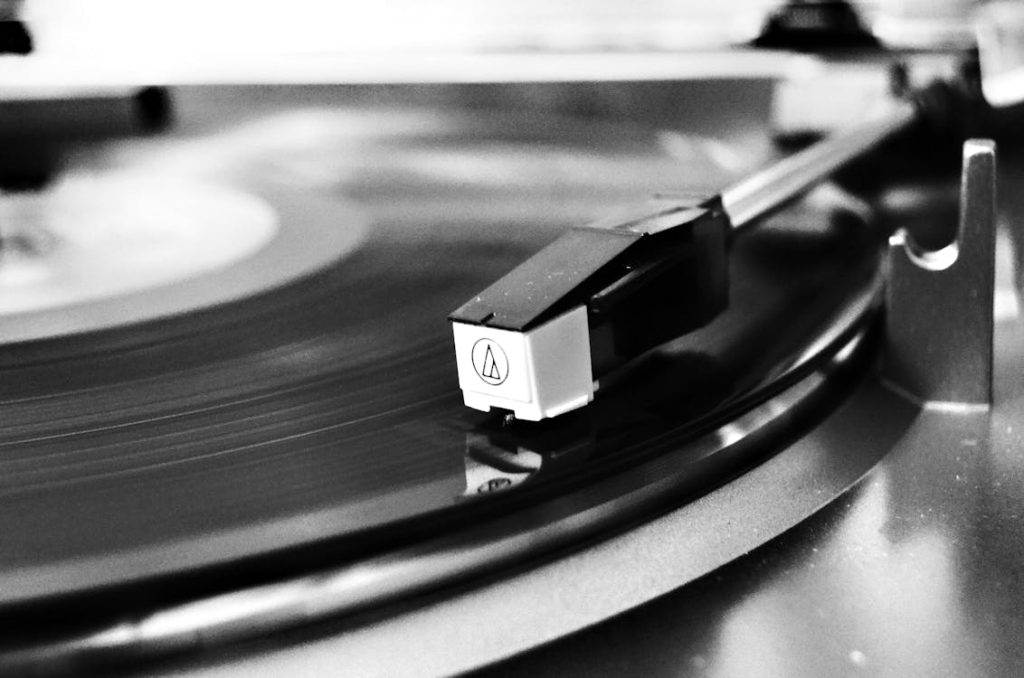
  • Clean with a stylus brush, back to front, never side to side. Side-to-side wear loosens the cantilever.
  • Replace every 500–1,000 hours of play time. A worn diamond is round instead of pointed — it sits high in the groove and damages records.

The five-minute weekly routine

Want to keep your collection in audiophile condition without making it a hobby? Five minutes a week:

  • Wipe the dust cover and platter mat with a microfibre cloth.
  • Brush the stylus tip with a soft stylus brush.
  • Re-sleeve any records that were left on the platter.
  • Glance at your storage shelf — is anything stacked? Leaning at a sharp angle? Fix it now.

That’s it. Five minutes a week, and the records you buy today will sound the same in twenty years. Every record we ship at Blacknote arrives in an anti-static inner sleeve and a poly outer — but the rest is up to you.

Posted on Leave a comment

Decoding Goldmine Grading: A Vinyl Buyer’s Glossary

Walk into any record shop, scroll any online seller, and the same six abbreviations will appear next to every used record on offer: M, NM, VG+, VG, G+, G. These letters were standardised in the 1970s by Goldmine magazine — the United States’ authoritative vinyl publication — and they remain the lingua franca of record buying today. Get the grading wrong, and you’re either overpaying for a battered LP or missing out on a sealed treasure. Here’s how to read the code.

Why grading even exists

Records degrade physically — they’re soft plastic discs played back by a needle dragged across their surface — and they degrade visually, with sleeves that yellow, split, and tear. A grading system gives buyers and sellers a shared vocabulary for two distinct properties:

  • The vinyl itself (how it sounds, how the playing surface looks).
  • The sleeve and inserts (the jacket, inner sleeve, lyric inserts, posters).

A serious seller will grade both. A casual seller will conflate them. Always read closely.

The Goldmine grading scale, top to bottom

Mint (M) — perfect

Sealed in factory shrink, never opened, never played. A true Mint record has no manufacturing defects and shows zero handling. Most “Mint” listings are mislabelled — outside of unopened originals and modern reissues, real Mint is rare. Pay accordingly.

Near Mint (NM or M-) — looks unplayed

The realistic top grade for anything that’s been out of the shrink wrap. Vinyl is glossy black with no marks visible under direct light. The sleeve has crisp corners, no seam splits, no ring wear, no writing. Maybe played once or twice on excellent equipment. This is the grade most audiophiles target.

Very Good Plus (VG+) — minor cosmetic, sounds great

A record that’s been gently used. Light surface marks visible at an angle but no deep scratches. Plays back with minimal-to-no surface noise. Sleeve has one or two small imperfections — a soft corner, light ring wear, a tiny seam start. VG+ is where most collectors get their best value for money.

Very Good (VG) — audible wear, still listenable

Surface marks are obvious; you’ll hear them as occasional ticks or crackle in quiet passages. The music itself is intact and enjoyable, but a discerning ear will notice. Sleeves at this grade often have writing, more pronounced ring wear, or a small seam split. Acceptable for hard-to-find titles where higher grades are scarce.

Good Plus (G+) — heavily played

Continuous surface noise throughout. Skips possible on damaged tracks. Sleeves often have tape repairs, water marks, or significant tears. Generally only worth buying for very rare records where a better copy is essentially unobtainable, or for music you simply want to hear at almost any cost.

Good (G) — collector relic, not a listener

Plays through, but barely. Constant noise, possibly skips, audible damage. Most G records have value only for completists or for the sleeve art. Don’t pay more than a token amount.

How we grade at Blacknote

Our policy is simple: we grade conservatively. If a record sits between two grades, we list the lower one. We inspect every used record under a bright neutral light, audition the side most likely to show wear, and note any defects — pressing flaws, edge warps, off-centre holes — in the listing.

Before any used record ships, we send the buyer a short video over WhatsApp of the actual record being inspected. If the actual condition differs from our grading, the order is refunded before it leaves our table.

Red flags when shopping elsewhere

  • “Plays VG+, looks VG” — a hint that the seller is reluctant to fully commit to VG+. Treat it as VG.
  • “Mint condition” on an unsealed original — almost always misleading. Ask for Near Mint or better.
  • No mention of the sleeve grade — assume the sleeve is at least one grade lower than the vinyl.
  • No mention of inserts — for albums that originally shipped with posters, lyric sheets, or stickers, the absence of these can halve the value.
  • Photos that hide the playing surface behind a paper sleeve or that show only the gatefold — ask for a clear shot of the record under direct light.

Read a grade like an audiophile

The grade alone doesn’t tell you everything. Always cross-reference:

  1. Pressing country and matrix. An original UK Blue Note in VG often outranks a modern reissue in NM.
  2. Label details. First pressings often command a premium; reissues, even if pristine, may not.
  3. Sleeve completeness. Original inner sleeves, posters, hype stickers, OBI strips on Japanese pressings — all factor in.
  4. The seller’s return policy. A confident seller offers grade-mismatch protection. We do.

Once you’ve internalised the scale, buying records gets easier — and a lot cheaper. The best collections are built by people who know the difference between VG+ and Near Mint and only pay the premium when it’s genuinely warranted.

Posted on Leave a comment

The Art of the Side B: Why Flip-Side Tracks Define Bollywood’s Golden Age

There is a quiet conspiracy at work in every great Bollywood record from the 1960s and 70s. The film studios promoted their hit songs on Side A — the peppy duets, the soaring title tracks, the melodies designed for transistor radios and film trailers. Side A was commerce. Side B was something else entirely.

Flip a copy of Guide (1965) and you land on “Wahan Kaun Hai Tera,” S.D. Burman’s most searching composition, a song that feels less like film music and more like a private conversation with God. Flip Pakeezah and you find “Mausam Hai Aashiqana,” Ghulam Mohammed’s fragile masterpiece, recorded just weeks before his death.

This is the Side B principle: freed from the obligation of the hit, composers and music directors allowed themselves to follow a different instinct. Slower tempos. Unusual ragas. Lyrics that did not resolve into reassurance. The orchestration stripped back to strings and silence.

The Economics of the Flip

In the 78 RPM era, both sides of a record were essentially equal. The single format as we know it — with its mandatory A-side hierarchy — consolidated during India’s shift to 45s and 33s through the late 1950s. By the time the LP dominated, the Side B mythology was fully formed.

Collectors have known for decades what casual listeners are only now discovering through streaming: the depth of Indian film music lies in its corners. The transition piece between two dance numbers. The philosophical couplet tucked after the main theme. The version of a song recorded for the soundtrack album that differs, in tempo or orchestration, from the cut used in the film.

Start digging in the right places — flea markets in Old Delhi, the back shelves of Palika Bazaar, or a well-curated vinyl shop — and the Side B rewards are extraordinary. Lata Mangeshkar at her most unguarded. Rafi working in a modal space that has no western equivalent. Kishore Kumar doing something you cannot quite name.

The point of vinyl, ultimately, is this: it forces you to commit. You choose a side, you lower the needle, and you listen to what was actually recorded rather than what the algorithm decided you wanted. Side B is where the music hid everything it truly meant.

Posted on Leave a comment

Crate Digging 101: How to Grade a Used Vinyl Record

There is no skill more useful to a vinyl collector than the ability to grade a record accurately in thirty seconds. Every used copy you encounter carries a history written in its surface: the parties it attended, the needles that tracked it, the sleeves that protected it (or didn’t). Learning to read that history is how you avoid expensive mistakes and how you find extraordinary pressings that others have undervalued.

The Goldmine grading scale — Mint, Near Mint, Very Good Plus, Very Good, Good, and below — is the industry standard. Here is what each grade actually means in practice.

Mint (M)

Unplayed. Still sealed, or opened but never put on a turntable. The pressing is factory-perfect; the sleeve is unhandled. Mint copies of desirable Indian pressings — original HMV 78s, early Columbia LPs — are genuinely rare. If someone is grading a used record as Mint, be sceptical.

Near Mint (NM)

The highest practical grade for a played record. Under a strong light you may see one or two hairlines, but they do not affect playback. The sleeve has no more than the faintest ring wear or corner softening. A Near Mint Indian original from the 1960s is the target grade for any serious collection.

Very Good Plus (VG+)

Light surface marks that may produce an occasional faint tick but no groove damage. This is the sweet spot for most collectors: visually imperfect but sonically excellent. The majority of the market trades in VG+ copies.

Very Good (VG)

Clearly visible marks; some background surface noise on quiet passages. Still enjoyable on a good turntable with a quality stylus. Acceptable for rare titles with no better copies available.

The Visual Check

Hold the record at a forty-five degree angle to a bright light source — a single bare bulb is ideal. Rotate the disc slowly. Hairlines will catch the light differently from pressed grooves. Scratches that run with the grooves are less damaging than those that cut across them. Deep radial scratches almost always cause skipping and are a dealbreaker.

Check the label for writing (owner’s names reduce value), water damage (indicates the record was stored badly), and sticker residue. Check the sleeve for seam splits, which indicate the record was stored horizontally under weight. Check the inner sleeve: a paper inner that has worn down the vinyl surface will show as a grey bloom on the record face.

With Indian pressings specifically: look for the matrix number hand-etched in the dead wax. Original pressings will show hand-stamped catalogue numbers; reissues are often machine-stamped. For HMV India pressings, a “GRAMOPHONE CO. OF INDIA” credit in the dead wax indicates an early pressing. These details take five seconds to check and can mean a price difference of several thousand rupees.

Posted on Leave a comment

Five Records That Defined the Sound of 1970s Hindi Film Music

The 1970s were the most creatively turbulent decade in the history of Hindi film music. The old guard — Shankar-Jaikishan, Madan Mohan, Roshan — were either fading or gone. New voices were arriving, absorbing everything from qawwali to funk, from Carnatic classical to European orchestral pop, and recombining it in ways that had no precedent. These five records document that decade’s finest hours.

1. Amar Prem — R.D. Burman (1972)

Pancham’s masterpiece, and the record that announced how far Bollywood could travel from its classical foundations while remaining entirely itself. “Chingari Koi Bhadke” is harmonically ambiguous in ways that Western pop of the same period was not even attempting. The original HMV pressing captures the orchestral depth that streaming simply cannot reproduce.

2. Parichay — R.D. Burman (1972)

Where Amar Prem is melancholy, Parichay is anarchic. “Musafir Hoon Yaaron” became so embedded in the culture that it now feels prehistoric — but hearing it on vinyl, at volume, is a reminder that it was once a genuinely strange and radical piece of music. The rhythm section alone justifies the price of admission.

3. Koshish — Madan Mohan (1972)

A film about deaf-mute protagonists, scored by the composer most obsessed with the human voice. The apparent paradox produced Madan Mohan’s most purely orchestral work, a record that proves you can communicate everything with strings and woodwind that a lyric might have stated in words. Deeply underrated outside of serious collector circles.

4. Namak Haram — R.D. Burman (1973)

“Diye Jalte Hain” is the most perfectly produced Kishore Kumar recording of the decade. The original pressing shows dynamic range that justifies every rupee of a proper turntable setup. This is also the record that introduced a generation of listeners to Burman’s use of silence — the rests between phrases that feel as musical as the notes themselves.

5. Mili — S.D. Burman (1975)

The elder Burman’s final completed score, and one of the most emotionally concentrated records in the canon. The interaction between Lata Mangeshkar and the chamber orchestra on “Badi Sooni Sooni Hai” is, in this writer’s view, the finest three minutes in the history of Hindi film music. Seek an original pressing. Do not accept a reissue.

All five records are available in original pressings if you know where to look. The search is part of the pleasure.

Posted on Leave a comment

Crate Digger’s Delhi: Where the City Hides Its Vinyl Gold

Every city has its record-hunting terrain, but Delhi’s is uniquely layered — stratified with the sediment of half a century of film culture, classical music patronage, and a middle class that once bought LPs the way it later bought cassette tapes: compulsively, abundantly, and then largely forgot about them.

That forgetting is your opportunity.

The Lay of the Land

Lajpat Rai Market in Chandni Chowk is the obvious starting point, and for good reason. The electronics wholesale district has, in its margins and side lanes, a handful of shops that have been dealing in second-hand audio equipment since before the cassette era. The vinyl here tends toward the practical — HMV pressings of Lata and Rafi, worn Decca jazz imports, the occasional treasure buried under a stack of 78s that were never properly sorted.

Come early. The good pieces surface before 10 a.m. and disappear into someone’s bag before noon. Bring cash in small denominations. Negotiation is expected, but walking in aggressive will cost you goodwill with dealers you will want to visit again.

The Sunday Circuit

The more productive hunting ground, for those willing to give up their Sunday mornings, is the informal market that spreads along the periphery of Janpath each weekend. Here, among brass figurines and old film magazines, you will find a dozen-odd sellers who have accumulated vinyl from house clearances, ancestral estates, and the remnants of closed clubs and hotel ballrooms.

The condition is wildly variable. You will flip through fifty sleeves to find three worth considering. But those three — a first-pressing RD Burman orchestration with its EMI insert intact, an imported jazz LP someone’s grandfather brought back from London in 1969, a sealed Zakir Hussain on the World Pacific label — are the reason people keep showing up at dawn.

Always check the groove before buying. Learn to read the surface: a shiny record with no deep circumferential scratches is almost always playable. A cloudy, hazy surface is not, regardless of what the sleeve looks like.

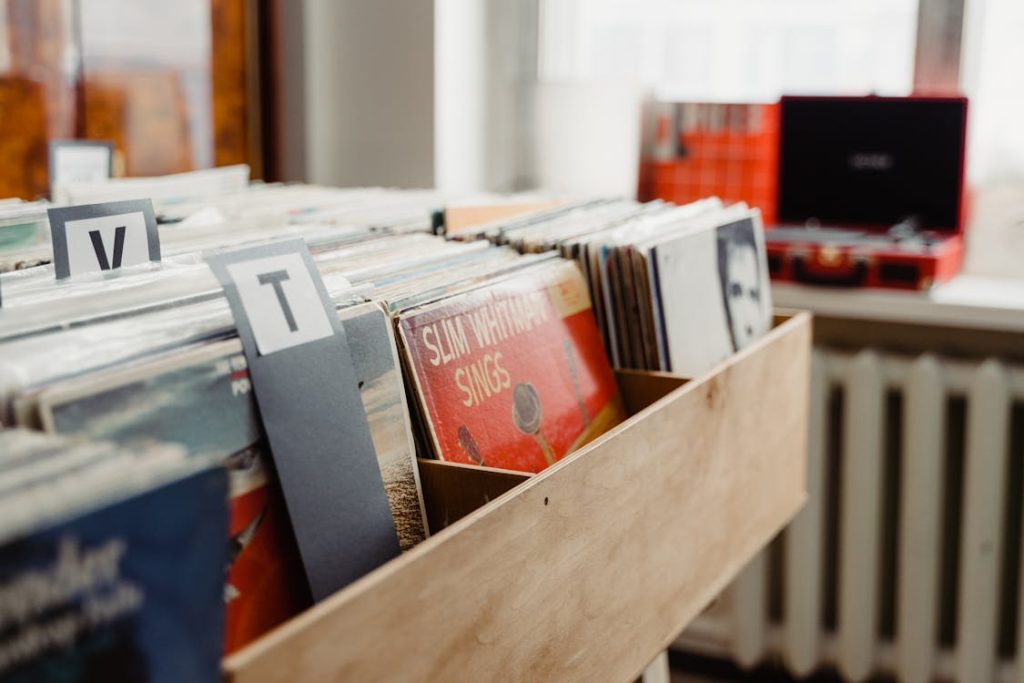
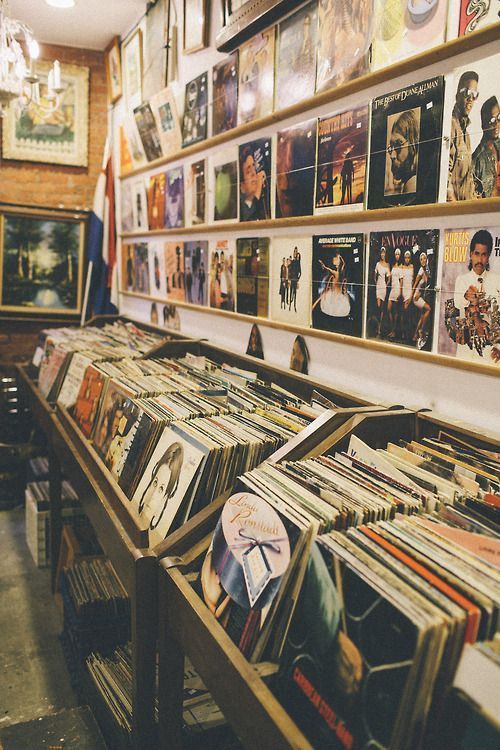
Hands browsing through vinyl records in a music store

What to Look For

The most undervalued category in Delhi’s second-hand market is 1970s Hindi film music on the original HMV Odeon label. These records were pressed in enormous quantities, but many were played to death or stored badly. A clean, flat copy of a Pancham score — Hare Rama Hare Krishna, Amar Akbar Anthony, Sholay, Kati Patang — commands serious prices among collectors internationally, but still turns up at domestic flea-market rates if you know where to look and what to look for.

Equally overlooked is Indian classical on the old Columbia and Odeon labels from the 1960s. Pressing quality on these is exceptional — EMI India’s plants produced vinyl that rivals contemporary audiophile pressings in terms of dead-wax depth and channel separation. A clean Vilayat Khan sitar record on the red-label Columbia from this era is not just a collectible. It is one of the finest listening experiences available on vinyl, anywhere in the world.

The Real Reason You Go

Every serious crate digger will tell you that the find is only part of it. The real pull is the conversation — with the dealer who has been selling since the 1980s and remembers which film star used to stop by, with the other collector rifling through the same bin, comparing grading standards and swap lists.

Delhi’s vinyl underground is small enough that everyone eventually knows everyone, and generous enough that newcomers are welcomed rather than guarded against. Show up. Flip through the crates. Ask the dealer what came in last week.

That, more than any specific address or map pin, is where the hunt begins.

Posted on Leave a comment

The Ritual: Why Playing a Record Is an Act of Presence

There is a moment, known to every vinyl listener, that streaming has never been able to replicate. It happens somewhere between lifting the record from its sleeve and lowering the stylus to the groove — a pause, barely a second long, in which the whole of your attention collapses into a single act.

This is the ritual. And it changes everything about how you hear.

The Weight of Intention

When you open a streaming app and hit shuffle, you are choosing music the way you scroll through a feed — passively, without commitment. The algorithm serves you a continuous stream and you half-listen while doing something else. There is no ceremony. There is no cost of entry.

Vinyl demands the opposite. You have to decide what you want to hear. You walk to the shelf. You flip through the sleeves. You pull out the record, hold it to the light, inspect the surface for dust. You clean it, if it needs cleaning. You lift the tonearm, set the speed, lower the stylus with the care you would give to something fragile and irreplaceable. You have crossed a threshold. The music, when it comes, is music you have chosen — not music that arrived by default.

That choice is not trivial. Deliberate engagement deepens experience. When the brain anticipates a reward it has actively pursued, the response is richer. Music you have gone through a ritual to hear sounds better — not just because the medium is warmer, but because you are more present for it.

The Crackle as a Feature

The first thing a new vinyl listener notices is the surface noise — the faint hiss and crackle that lives just beneath the music. Their first instinct is to hear it as a flaw. Their second instinct, which usually comes a few weeks later, is to understand that it is not.

The crackle is a timestamp. It is the sound of physicality: a needle tracing a spiral cut into lacquer, the accumulated evidence of decades of play and storage, all the hands that have held this disc before yours. It is proof that the music exists as an object in the world rather than a weightless file in a server farm. Some listeners describe a record with a gentle crackle the way wine people describe terroir — it is the sound of where and when, embedded in the medium itself.

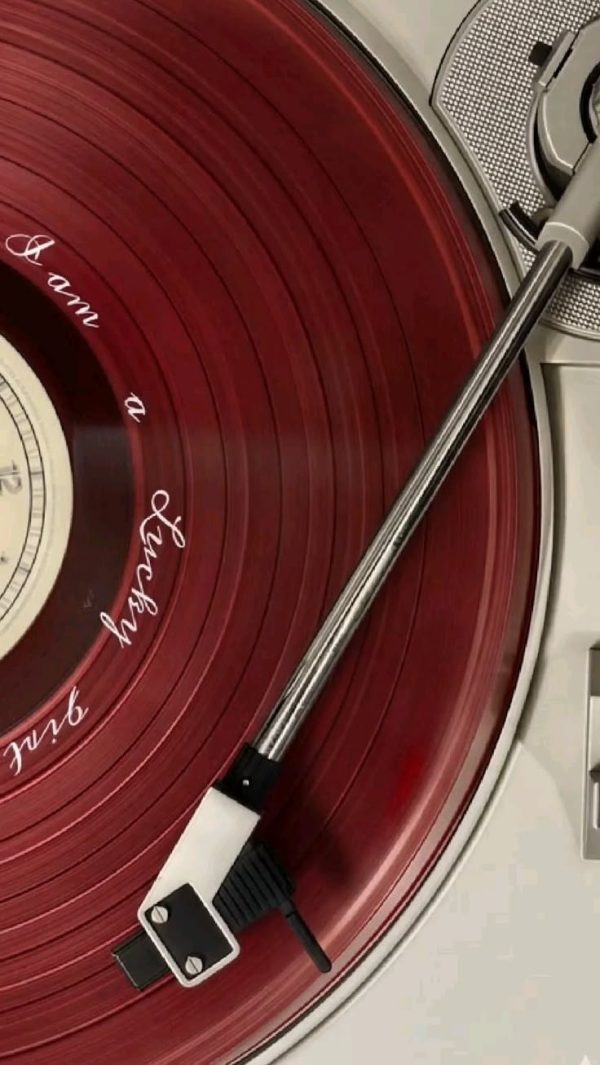
A vinyl record spinning on a turntable, warm tones

Side One. Flip. Side Two.

One of vinyl’s quietest gifts is the album side. Somewhere between 18 and 22 minutes, the music ends. You get up. You walk back to the player. You lift the arm, flip the record, lower the needle again. It is a forced interval — not a pause the app inserted, but a breath you chose to take.

Digital music abolished the interval in the name of convenience. But convenience, as every serious listener eventually figures out, is the enemy of depth. The interval between sides is where the first half of an album settles in you — where what you have just heard begins its slow migration from sensation into memory.

The Record as Object

A record has a front and a back, typography and photography, liner notes written by someone who cared enough to write them. It has weight. It has the particular smell of old vinyl or fresh pressings, neither of which a speaker can reproduce. It can be damaged, and therefore it must be respected.

In respecting the object, you learn to respect what is inside it. That is the whole of the ritual. And it is enough.